Archive Scope Checklist
Confirm in-scope record types, attachments, business identifiers, retention rules, legal holds, and access boundaries before starting extraction.
Download DOCXDecide what to extract, build a searchable archive, prove completeness and access controls, and get sign-off to shut down the source system.
Latest update · Legacy archiving update for November 14–27, 2026 · Published
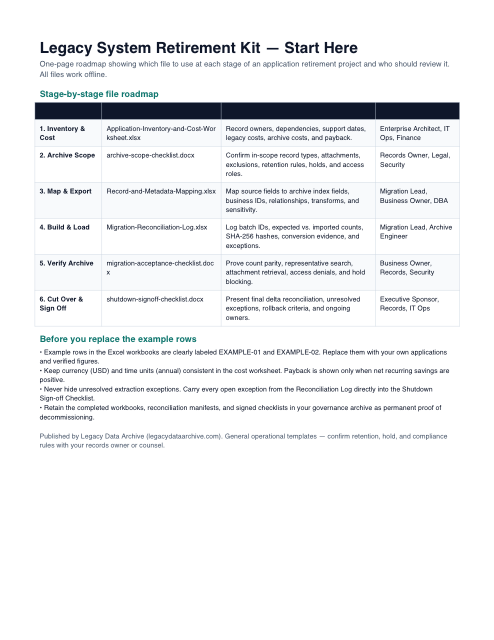
Plain, reusable templates that work offline—ready for migration leads, records owners, and approvers.
Direct download, no email required. Preview contents & individual files.
Follow the sequence from application inventory and archive scope through AWS build, pre-shutdown verification, and operational handoff.
Work through all 3 checklists online, print them with your sign-off notes, or download editable Word copies for your project file.
Confirm in-scope record types, attachments, business identifiers, retention rules, legal holds, and access boundaries before starting extraction.
Download DOCXVerify count reconciliation, file integrity and transformation evidence, representative searches, attachment retrieval, access denials, and hold behavior before cutover.
Download DOCXPresent final delta reconciliation, unresolved exceptions, rollback criteria, and post-shutdown ownership to approvers before decommissioning the source system.
Download DOCXLegacy archiving update for November 14–27, 2026 · Published
Lasernet changes the path used by archive integrations, and the Digital Preservation Coalition seeks case studies on records with software or format dependencies.
Proposals about preserving email, software, research data, web archives, and legacy media are due December 19 at 11:59 a.m. UTC.
Published Event Proposal deadline (11:59 a.m. UTC): Dec 19, 2026
Proposed revision DAA-GRS-2027-0001 updates federal retention rules for email and electronic messages managed under Capstone. Comments are due January 8, 2027.
Published Event Comment deadline: Jan 8, 2027
Arkivum’s early-access module lets customers query tabular data exported from retired systems. The core 6.9 release also adds list-based exports and file-format metadata at ingest.
Published Event
For teams with an active retirement project, FormKiQ runs in your own AWS account with structured metadata, role-based access, legal holds, and full-text search.